
Rubber is one of the world’s most versatile and essential materials, playing a critical role in industries from automotive to construction, footwear, and beyond. In 2026, the global rubber market is valued at USD 68.93 billion, with projections to nearly double by 2035, reaching USD 137.77 billion at a compound annual growth rate (CAGR) of 8%. This growth is driven by rising demand in emerging economies, technological advancements, and the expanding automotive sector. Yet behind the surface lies a complex and increasingly urgent story – one that spans environmental strain, supply chain vulnerabilities, and the search for sustainable rubber solutions.
In summary, natural and synthetic rubber together support industries worth hundreds of billions of euros annually. The core issue is not just the volume of rubber we use—it is how we produce it. Traditional models rely either on fossil-based inputs or intensive monoculture farming. Both approaches struggle to meet modern expectations for sustainability, traceability, and resilience.
Synthetic rubber makes up around 60% of the rubber market share and ties rubber production directly to petrochemical supply chains and associated carbon emissions. As industries push toward decarbonization, this dependence is becoming increasingly difficult to justify.
Most of the natural rubber used today comes from rubber tree plantations, concentrated primarily in Southeast Asia. While this system has scaled efficiently to meet demand, it has also contributed to deforestation, biodiversity loss, and socio-economic challenges in producing regions.

At the same time, demand is not slowing down. With global mobility increasing and emerging markets expanding, the need for rubber continues to grow. This creates a clear gap: how can we meet rising demand without amplifying environmental and social costs?
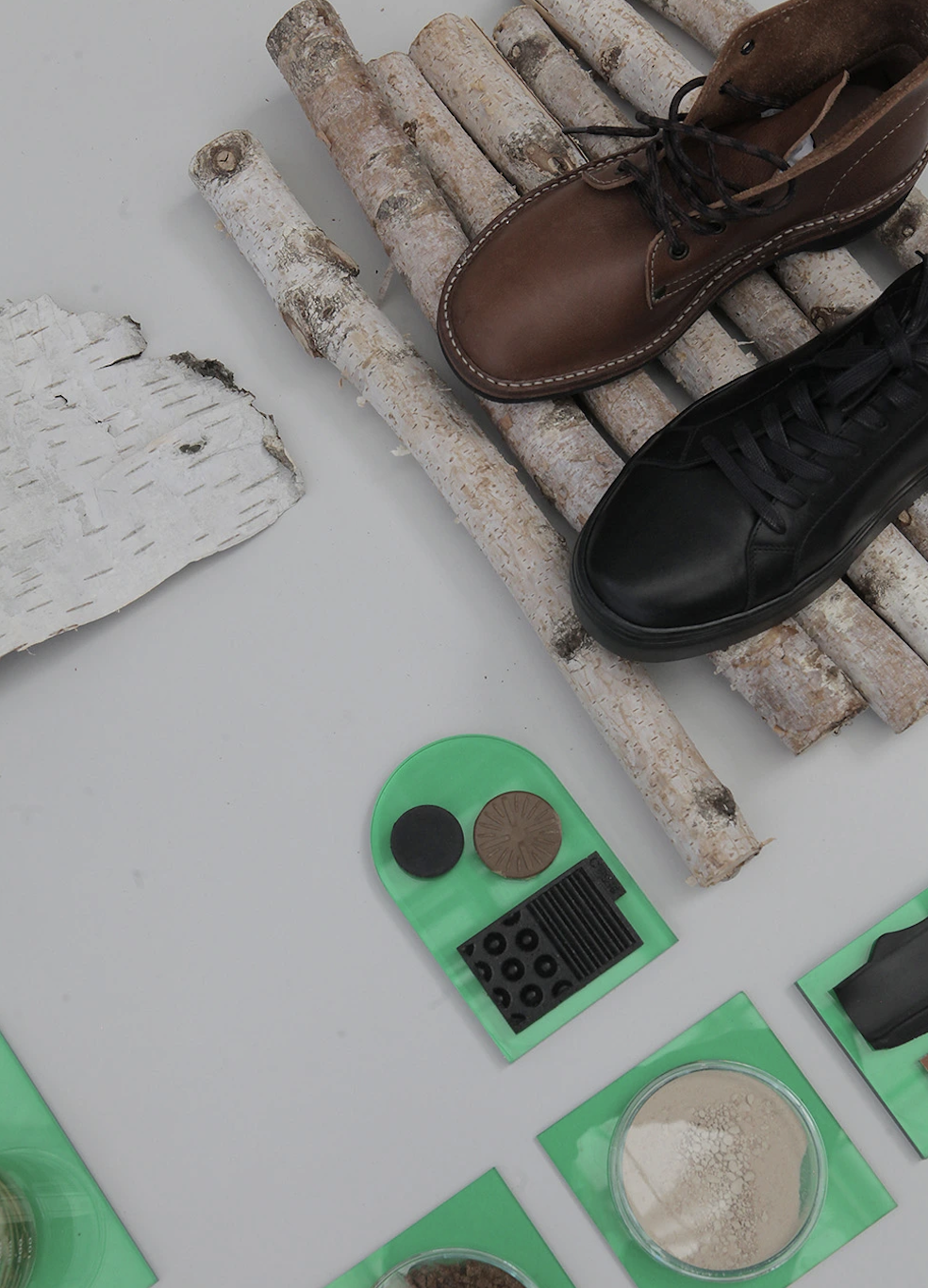
Innovations in material science are beginning to challenge conventional assumptions about rubber production. Our emerging approach focuses on utilizing forestry side streams – specifically bark – as a raw material. In this model, no additional trees are cut down. Instead, bark from trees already felled for other industrial purposes such as paper, packaging and wood products becomes a valuable input. This not only reduces waste but also decouples rubber production from deforestation pressures and represents a shift from extraction to utilization of existing resources that otherwise are mostly burned as fuel.
To put this into perspective: bark from a single tree can produce enough material for approximately 24 shoe soles. Scaled across forestry operations, this represents a significant untapped resource built around renewable resources and smarter material utilization.
This transition also reflects the broader principles of a circular economy, where industrial byproducts are reintegrated into value chains instead of discarded or burned.
The transition from new material innovation to real-world application is often the most challenging step. However, progress is already underway.
Currently, Reselo Rubber is being promoted in footwear outsoles, where durability, flexibility, and performance are critical. Technical validation has already been achieved with several footwear brands, and the first shoes are on the market. Production capacity is also evolving rapidly and we will have the capability to produce millions of pairs of outsoles within the next years. The footwear customer base is diverse and accessible, with many brands actively seeking sustainable material innovations and open to working with smaller, agile suppliers. The industry offers short development cycles and smaller initial volume requirements, enabling faster validation, earlier revenue, and stepwise scaling. In addition, footwear brands operate closer to end consumers, where sustainability credentials can be purchasing and premium-price driver.
At the same time, footwear represents a significant and often overlooked environmental challenge. Approximately 22 billion pairs of shoes are produced annually, most using fossil-based rubber compounds that contribute to emissions, microplastic pollution, and waste. By prioritizing footwear, we can address a high-impact market today while building the industrial and commercial foundation needed to scale toward tires.

Long term, tires are where we can make the most impact – 70% of the rubber use globally is applied in tires. Initially, after screening different rubber industries, we doubted whether it would make sense for us to interact with the tire industry. The enormous size of the industry, and even more so their mostly conservative thinking, led to the conclusion that we, as a small, innovative company with little resources would not be a good fit for them. Early validation through partnerships with global industrial players has however made it possible: Reselo won Nokian Tyres’ FAST RACE, BIG CHANGE innovation challenge and now works closely with Nokian Tyres to adapt its renewable material for commercial tire applications, aiming to contribute to more sustainable mobility solutions. We want to contribute with rubber alternatives that can offer better performance and at the same time reduce environmental impact..
In parallel, Reselo has been exploring material applications with the automotive industry e.g. Scania, testing components of commercial vehicles to evaluate performance in transport contexts that could also be used at large scale.
The future of rubber will depend on a combination of innovations that maintain performance and scalability at centre while allowing for a reduced carbon footprint and more sustainable products. What is clear is that the industry is at a turning point. Materials that were once considered waste are being reimagined as valuable resources. Supply chains are being redesigned to be more circular. And companies are beginning to align material choices with long-term sustainability goals.
Rubber may be one of the oldest industrial materials still in widespread use but how we produce it is rapidly changing. The shift from extraction to regeneration is already happening, and the rise of sustainable rubber solutions will play a critical role in shaping the future of global industries.